Guildhall 0.10.0
Guildhall 0.10.0 is about making the project shell feel less scattered. When Guildhall needs your judgment, it keeps that conversation in Threads. When you need to understand project shape, Structure is the map room. When work crosses project boundaries, Guildhall can show who provides the work, who checks it, and what is still waiting.
What changed
- Bounded owner-input conversations: New Request, intake, and project questions can open a focused conversation in Threads. The session closes with a receipt instead of leaving durable truth buried in a long transcript.
- Needs you as an alert queue: active conversations and approvals belong in Threads. Needs you points at the right surface instead of creating a second question model.
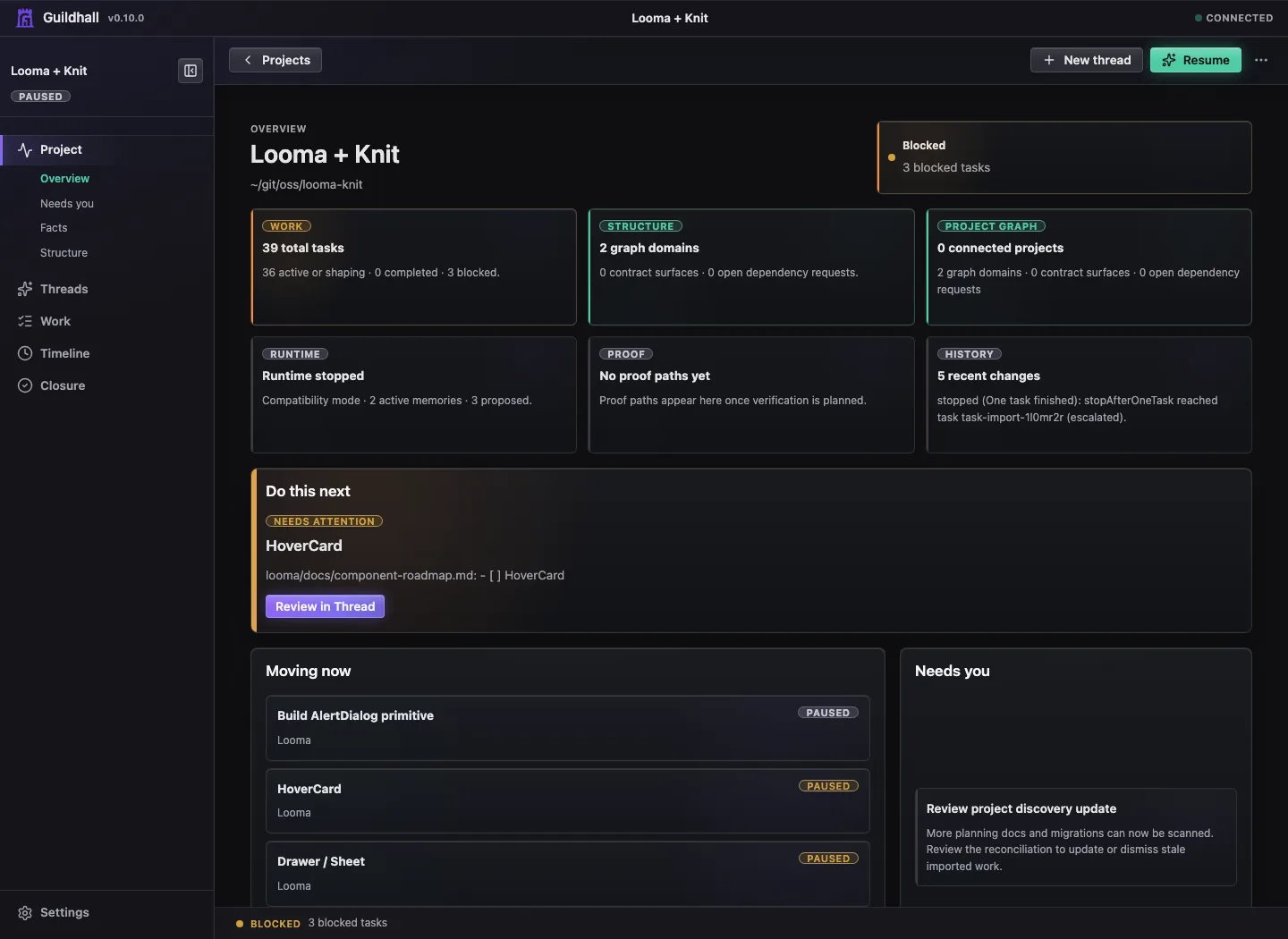
- Cleaner project rail: Project is the owner-facing project room, with Overview, Needs you, Facts, and Structure grouped together. Threads, Work, Timeline, and Closure remain top-level work modes. Settings stays pinned as configuration instead of becoming a drawer for project-intelligence surfaces. A section's child links stay visible while you are in that section, then hide when you move somewhere else.
- Structure as the map room: structural maps, project graph responsibilities, provider/consumer requests, setup review, and shared contract surfaces now live in Structure instead of being spread through Settings.
- Local project graph handoffs: Guildhall can represent local projects, domains, responsibility facets, provider requests, deliveries, consumer returns, and final acceptance without letting one project silently mutate another project's state.
- Contract surfaces: specs can carry the shared API, component, schema, design-system, or provider boundary they touch, plus the proof reviewers need before accepting the change.
- State-machine receipts: new lifecycle-heavy flows use explicit events, guards, and receipts so screens agree about what is waiting, accepted, returned, blocked, or closed.
- Current-work closure: Closure stays focused on the work Guildhall is tracking now: reviewer verdicts, gates, Git Story blockers, local residue, and the checks that decide whether the current work is actually closed.
Visual tour
The 0.10 UI pass is mostly about putting each kind of work in its natural room. Projects & Workspaces stays shallow and helps you pick where to look next. Inside a project, the rail separates Project orientation from Threads, Work, Timeline, Closure, and Settings.
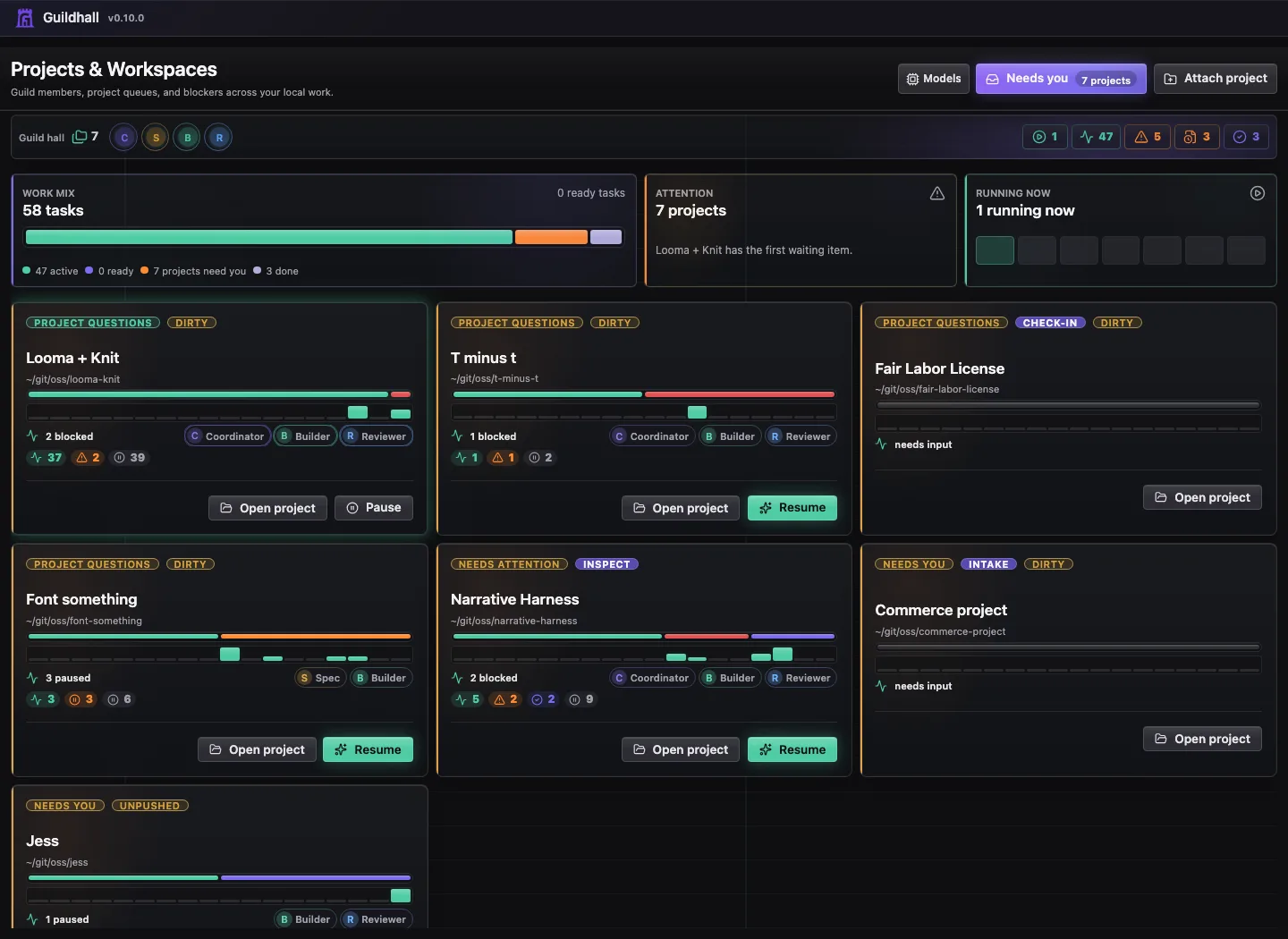
The project shell now has a tighter split:
- Overview summarizes attention, task health, blocked work, activity, and Git Story signals before you drill into a mode.
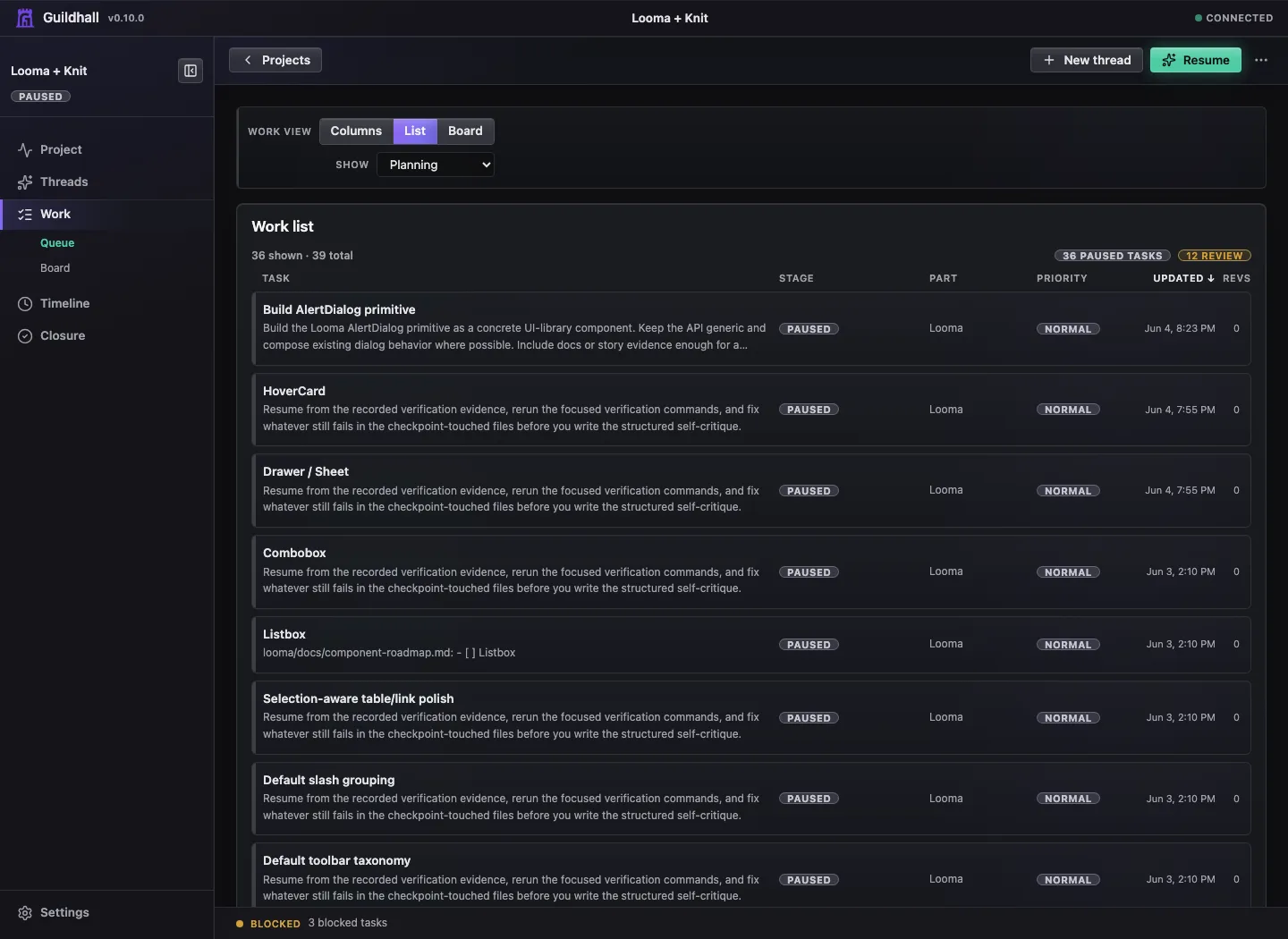
- Work is a dense queue and inspector surface for logical tasks, not a dump of every delivery step.
- Threads carries bounded conversations and owner-input receipts.
- Facts keeps durable project facts inspectable.
- Structure holds the structural map, project graph, and contract surfaces.
- Settings stays focused on readiness, providers, identity, profiles, and developer controls.
Why it matters
The old problem was not that Guildhall lacked information. It was that the information could land in too many places: a question card here, a settings panel there, a task drawer action somewhere else. 0.10.0 tightens that up.
Project owns orientation: Overview, Needs you, Facts, and Structure. Threads owns the conversation, Work owns the queue, Timeline owns activity history, and Closure owns the current-work verdict. Settings goes back to readiness, providers, identity, profiles, and developer controls.
That makes the next move easier to trust. You should be able to tell whether Guildhall needs an answer, a provider delivery, a consumer verification pass, a setup decision, or a closure cleanup without reading every tab first.
The edges
0.10.0 is still local-first. Remote planning systems can stay authoritative in the model, but this release does not claim remote project execution. The task lifecycle still has older status fields in places; the new state-machine substrate is proven on bounded chat, capability requests, structural review, and project-graph handoffs before broader lifecycle cleanup.
OpenRouter guided provider setup moved to a later release so 0.10.0 could stay focused on owner-input coherence and the operating map.